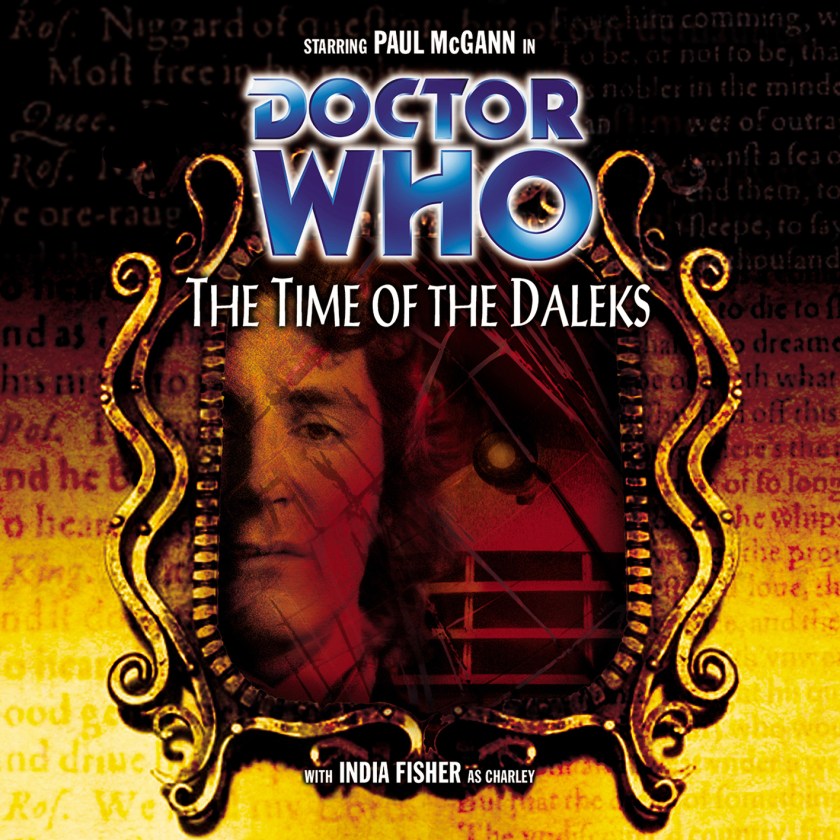
Written By: Justin Richards
Directed By: Nicholas Briggs
Featuring: Eighth Doctor & Charley
Release Date: May 2002
Big Finish Summary
The Doctor has always admired the work of William Shakespeare. So he is a little surprised that Charley doesn’t hold the galaxy’s greatest playwright in the same esteem. In fact she’s never heard of him.
Which the Doctor thinks is quite improbable.
General Mariah Learman, ruling Britain after the Eurowars, is one of Shakespeare’s greatest admirers, and is convinced her time machine will enable her to see the plays’ original performances.
Which the Doctor believes is extremely unlikely.
The Daleks just want to help. They want Learman to get her time machine working. They want Charley to appreciate the first ever performance of Julius Caesar. They believe that Shakespeare is the greatest playwright ever to have existed and venerate his memory.
Which the Doctor knows is utterly impossible.
*Warning: This review contains spoilers*
Introduction
The Daleks are searching for a playwright who the majority of 21st century New Britain has forgotten. The name of the playwright: William Shakespeare.
Plot
Time of the Daleks is the fourth and last full-length audio story in Big Finish Production’s Dalek Empire series. I have listened to the other three, those being The Genocide Machine, The Apocalypse Element and The Mutant Phase. With each release, the plots progressively became more complex. Whilst The Mutant Phase introduced alternate history and the Daleks’ ability to time travel, it reached another level here. The web of time itself is under threat, with Earth’s history constantly changing between the familiar and the dystopian. Should the Daleks succeed with their plan, Earth would have always been theirs, and humanity their slaves. We visit an alternate 1572, which is very bleak indeed. A couple of elements really work for me on this front. First is how characters’ memories change depending on how close the Daleks are to changing time. In a chilling moment, the rebels forget about Shakespeare and believe they have been fighting the Daleks for years. Secondly, humanity having bad dreams of the alternate present effectively conveys a history that is ever-changing.
“A world of conformity. No individuals, just a mass of humanity following orders. A world with no thought, no imagination, no love.“
Viola – The Time of the Daleks, Part 1.
I love that the premise of this story stems from a throwaway line in Invaders from Mars, of all stories. There, Orson Welles had never heard of William Shakespeare, despite creating multiple plays of his works. The Doctor’s companion Charley (India Fisher), when queried, had also never heard of him. I have said this previously, but I am enjoying how connected the Eighth Doctor (Paul McGann) stories are. I also really like the setting of New Britain, a post-Eurowars country that is under a dictatorship. It has a great parallel with the ravaged alternate Earth under the Daleks control. It must also hit differently to this post-Brexit listener than it did to one in 2002! Finally, I like the rebel sub-plot; it definitely strengthened the comparison between Learman and the Daleks. It definitely did not outstay its welcome either, concluding at a perfect point in the story. The first half is very strong, both at building up tension and making the audience ask questions.
Unfortunately, the second half is not quite as strong. It spends much of its time trying to untangle the fine web that had been created earlier on. The climax of Part 2, which features four different groups of characters, was a sign of things to come. The main culprit in the mess of plot threads is the Daleks’ plan, which on first listen is incomprehensible. When there is no visual cue, as is the case for audio books, key information is given through dialogue. I have an issue with how the key information is delivered here. Part 4 is especially dense, with dialogue revealing elements of the Daleks’ plot being given little fanfare. I understood that the Daleks were trying to rescue their fleet in the time fissure. Working with Learman made sense, as her time experiments were compatible with the Daleks’ technology. But, when I first listened to this, I couldn’t work out how Shakespeare fit into those plans. Learman’s motivations to remove Shakespeare from time were crystal clear, albeit on the crazy side. The Daleks’ motivation for wanting Shakespeare dead is still a mystery. A better balance between the sparse Part 3 and the dense Part 4 would have made this easier to follow. I like that this story is one big time loop; it is a good fit with this run of stories. There are many things I love about the plot, particularly in the story’s first half. But, the denseness of the second half’s plot makes this a hard story to completely follow.
Characters
“Think of your worst nightmare. Think of the most repelling, nauseating, disgusting thing you could possibly imagine. Think of pure evil made malignant flesh.”
“And that’s what it’s like?”
“No. It’s a thousand times worse.”
The Doctor and Viola talking about the Daleks – Time of the Daleks, Part 2.
For the first time in this series, Doctor Who‘s most notorious villains have been backed into a corner. The story starts with a Dalek ship on the verge of destruction, its occupants rushing to flee. Their panicked calls to activate shields and escape felt novel for the start of a story. So often we have seen Daleks on the attack as a powerful and deadly force. Even with an end goal that feels suitably maniacal, they feel vulnerable throughout this story. Here, their vulnerability provokes an unpredictable side to them, which makes them feel more dangerous than ever. Their presence in a country manor feels unsettling, as do their recitals of lines from William Shakespeare’s plays. These easily could have veered into unintentional comic territory, but the chosen lines are very effective. Spoken in the Daleks’ cold and unemotional drone, each line feels like a thinly veiled threat. Being the final serial in the Dalek Empire arc, it was pleasing to hear several references to other stories. Intel gathered from their invasions of Gallifrey (The Apocalypse Element) and Kar-Charrat (The Genocide Machine) were used in their plan. Finally, the Emperor Dalek made a welcome reappearance. In my head canon, this is the same Emperor as in The Mutant Phase. This showcased a more vulnerable side to the Daleks, and tied together threads from other stories. It’s up there with the strongest Dalek representation in this series to date.
The leads are pitched well in this story. India Fisher is once again on fine form as the Doctor’s companion Charley Pollard. Her attempts to imitate an upper-class individual drew loud laughs, as did a scene involving sandwiches. As was the case in previous stories, Charley’s presence provides humanity and levity to what is a fairly dark narrative. She does have convenient plot armour at the end of Part 2, but this wasn’t a huge sticking point. Paul McGann’s Eighth Doctor is also pitched well for this story. His immediate distrust of the Shakespeare-spouting Daleks speeds up the reveal that they are false. His intelligence comes to the forefront in the story’s second half, moving one step ahead of humans and Daleks alike. In a complex story with multiple realities, time loops and paradoxes, the Doctor keeps the listeners on board. He also has a couple of cracking one liners among the technobabble. But, the outstanding Doctor moment comes at the very end of the story. After their encounters with time unravelling, the Doctor admits to Charley that he is scared. I love how much more human Paul McGann’s incarnation is than previous Doctors, and he sells this very well. The relationship between Eight and Charley is one of my favourites in this audio book series. Six audio book adventures in a row did lead to some fatigue, but never with the central pairing. Their final vulnerable exchange perfectly sets up the next story, the finale in this ‘season’.
There are a larger number of secondary characters in this story. Most of them fulfil a purpose, whether that be a plot point or cannon fodder. Thankfully, unlike the Eighth Doctor story Invaders from Mars, the majority of these can be differentiated. The characters can be split into two camps: those in General Learman’s house, and those outside of it. Those in the house include Learman, her niece Viola, Major Ferdinand, Professor Osric and the Kitchen Boy. Those outside the house are the rebels, which include Priestly and Hart. Excepting the latter two, who are hard to tell apart, it was straightforward to know who was speaking. This helped when the lines between the two groups became blurred. The blend wasn’t perfect; Part 2’s confusing cacophony of a cliffhanger contained too many characters. I like how the Daleks are portrayed, and the Doctor and Charley have some great moments. This isn’t the best display of characters for a Big Finish audio adventure but, generally, they compliment the story.
Listening Experience
“Time is out of joint. Time is come round, and where I did begin, there I should end. The dust on antique time would like unswept. Time that takes survey of all the world must have a stop. Cry havoc, and let slip the dogs of war. And thus, the whirligig of time brings in his revenges. To the last syllable of recorded time.”
Unknown – The Time of the Daleks, Part 1.
Time of the Daleks sounds like a classic Dalek story. The music that accompanies the Daleks feel grandiose, but with an unsettling undertone, which perfectly compliments their duplicitous nature. It harks back to music used in the classic TV series whenever the Doctor’s greatest enemies appeared on screen. But, at the same time, there is something contemporary in the use of sound. I can only recall a couple of times where narration began a story in the classic series. Here, the unknown individual from Seasons of Fear quotes a selection of Shakespeare plays to describe the unravelling of time. From Julius Caesar to Twelfth Night, the choice is an excellent portent to this adventure. Additionally, the use of incidental sound is also very effective, with two standouts. The 1,700 ticking clocks in the time machine room are grand yet disorientating, and the Dalek creatures are disgustingly squelchy. Whilst the soundtrack is more generic in the second half, the use of sound compliments the story’s nature and villains.
Being the fifth Eighth Doctor story in a row, there are multiple references to the previous four. We finally discover why there was a random Dalek in Roman England in Seasons of Fear. We learn why Orson Welles had never heard of Shakespeare in Invaders from Mars, despite adapting many Shakespeare plays. There are dialogue that references the revelations of The Chimes of Midnight. That is even before the other Dalek Empire stories come into play in the plot. The Kar-Charrat library (The Genocide Machine) and the Eye of Harmony (The Apocalypse Element) have influenced the Daleks’ plan. This is a very rewarding story for listeners who have listened to all of these other audio adventures. Whilst a good story in its own right, it is also a successful culmination of three years’ worth of stories.
Final Thoughts
The Time of the Daleks could never be described as a dull adventure. Chaotic, almost certainly; confusing, somewhat; boring, absolutely not. The jumble of paradoxes and alternate timelines, and this story overall, fit perfectly into this run of Eighth Doctor stories. The Dalek Empire quadrilogy changed what we have come to expect from the Daleks. Here, the Doctor’s greatest enemies feel truly menacing. With excellent dialogue and a cliffhanger that perfectly sets up future stories, this is not a story to be forgotten.
Ratings
Plot: 3.5/5
Characters: 4/5
Listening Experience: 4/5
Overall: 4/5
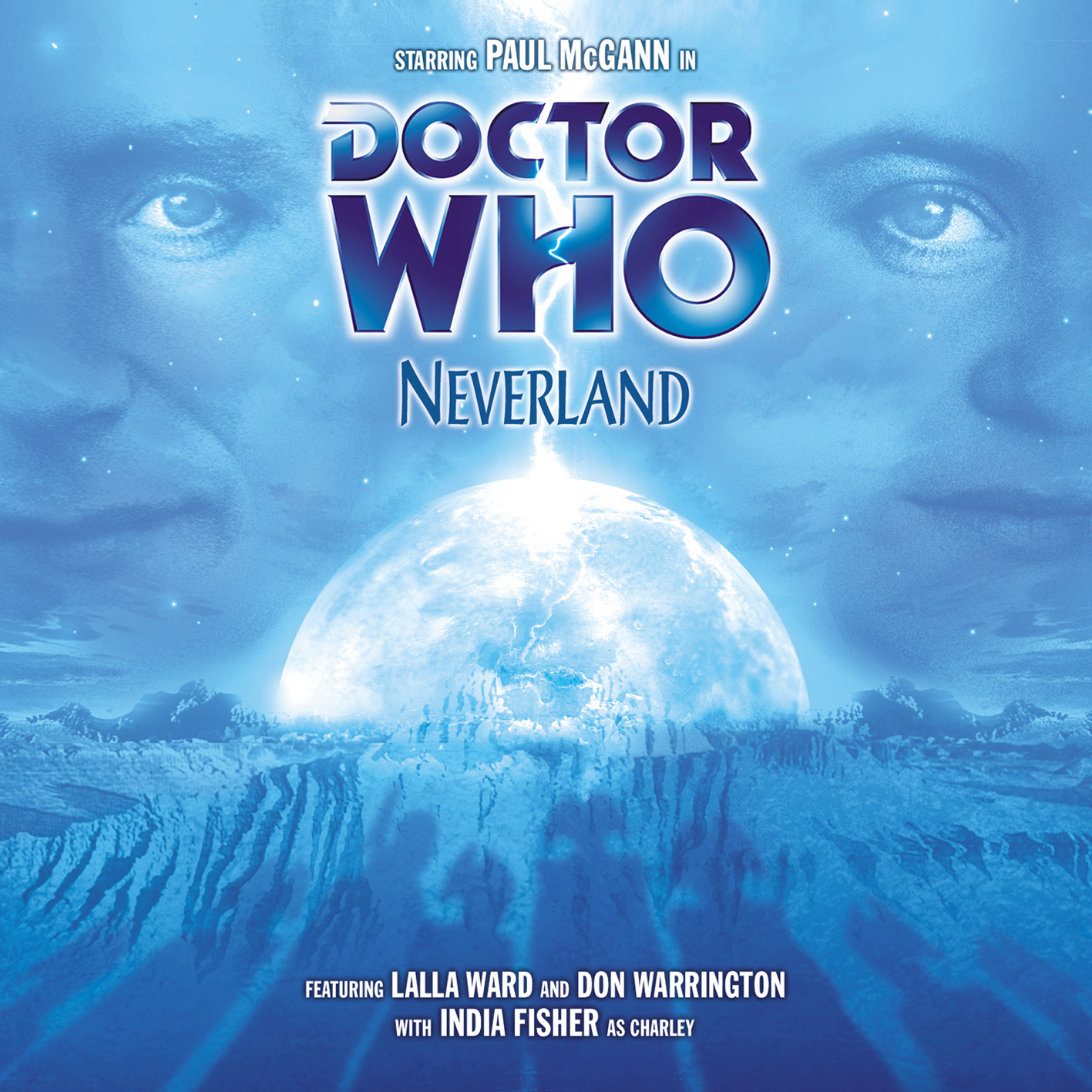
Next Time: Doctor Who: Neverland
The Web of Time is stretched to breaking. History is leaking like a sieve. In the Citadel of Gallifrey, the Time Lords fear the end of everything that is, everything that was… everything that will be.
The Doctor holds the Time Lords’ only hope – but exactly what lengths will the Celestial Intervention Agency go to in their efforts to retrieve something important from within his TARDIS? What has caused Imperiatrix Romanadvoratrelundar to declare war on the rest of creation? And can an old nursery rhyme about a monster called Zagreus really be coming true?
The answers can only be found outside the bounds of the universe itself, in a place that history forgot. In the wastegrounds of eternity. In the Neverland.
Thank you for taking the time to read my review of Doctor Who: The Time of the Daleks.
If you enjoyed reading this, please subscribe to The Blogging DJ to receive notifications when new posts are published. As well as my reviews of Doctor Who audio adventures, I also publish book and TV series reviews.
Every Doctor Who review on this site, whether that be TV or audio book stories, can be found here.
Is this one of the best Doctor Who audio adventures featuring the Daleks? Were you able to keep up with the paradox-heavy plot?
Please feel free to leave your thoughts in the comments section below. Also, if you have any recommendations or feedback, your comments will be much appreciated. Alternatively, please drop an email to editor@thebloggingdj.com.
Thank you again, and I’ll see you next time for my review of Doctor Who: Neverland.
 The Blogging DJ